
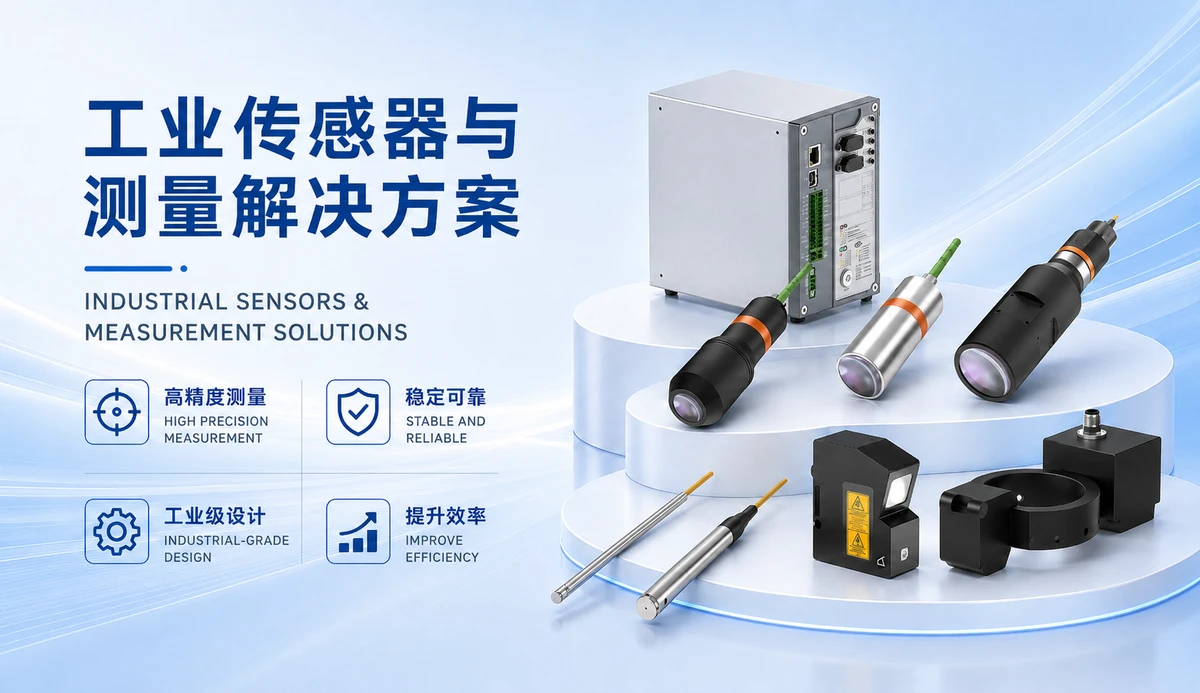
Neither technology is universally better for every PCB; selection depends on the target surface, accuracy, cycle time, integration constraints, and validation results. Laser displacement sensors suit common reflective surfaces and high-speed inline inspection; chromatic confocal sensors excel on transparent, highly reflective, or complex multilayer surfaces, offering higher accuracy but often slower cycle times. Choose based on your specific application and on-machine validation.
Measurement Principle Comparison
Laser displacement sensors use triangulation: a laser spot projects onto the target, and its position on a receiver array changes with distance. Chromatic confocal sensors use a dispersive lens to split white light into a continuous spectrum; only the wavelength focused on the surface is received, determining distance.
- Laser displacement: simple structure, fast response, ideal for most opaque surfaces.
- Chromatic confocal: robust on transparent, semi-transparent, and highly reflective surfaces, but requires a more complex optical system.
Application Boundary Analysis
Target Surface Characteristics
PCB components may include mirror-like leads, transparent encapsulants, or dark plastic bodies. Laser displacement can suffer from diffuse reflection interference on mirror or transparent surfaces, while chromatic confocal provides stable measurements.
Accuracy and Cycle Time
Chromatic confocal sensors typically offer higher resolution and repeatability, but sampling speed may be lower than laser displacement. For high-speed inline inspection, laser displacement is often preferred; for offline sampling or high-precision measurement, chromatic confocal may be better.
Selection Workflow
- Define component types and surface properties (reflectivity, transparency, roughness).
- Determine accuracy requirements (e.g., height tolerance, coplanarity) and cycle time.
- Evaluate installation space and measurement angle constraints.
- Compare response speed, resolution, and measurement range using official manufacturer data.
- Conduct on-site trials with actual PCBs, testing different colors, gloss levels, and tilt angles.
- Consider budget, commissioning complexity, and maintenance costs.
Comparison Table
| Aspect | Laser Displacement | Chromatic Confocal |
|---|---|---|
| Measurement principle | Triangulation | Chromatic confocal |
| Suitable surfaces | Opaque, diffuse reflective | Transparent, high reflective, multilayer |
| Accuracy | Standard | Higher |
| Cycle time | Fast | Relatively slower |
| Installation space | Usually compact | May require more space |
| Cost | Lower | Higher |
Frequently Asked Questions
Can laser displacement sensors measure transparent components?
Yes, but transmission and reflection interference may reduce accuracy; on-site testing is recommended.
Are chromatic confocal sensors slow?
Compared to laser displacement, sampling speed may be lower, but it depends on the model and configuration; verify with manufacturer data.
How to validate sensor selection?
Use actual PCB samples for trial measurements, testing standard parts and real components, and compare repeatability and accuracy.
Can both sensor types be used together?
Yes, they can be combined on a production line based on station requirements, but ensure unified data interfaces.