
Application Background
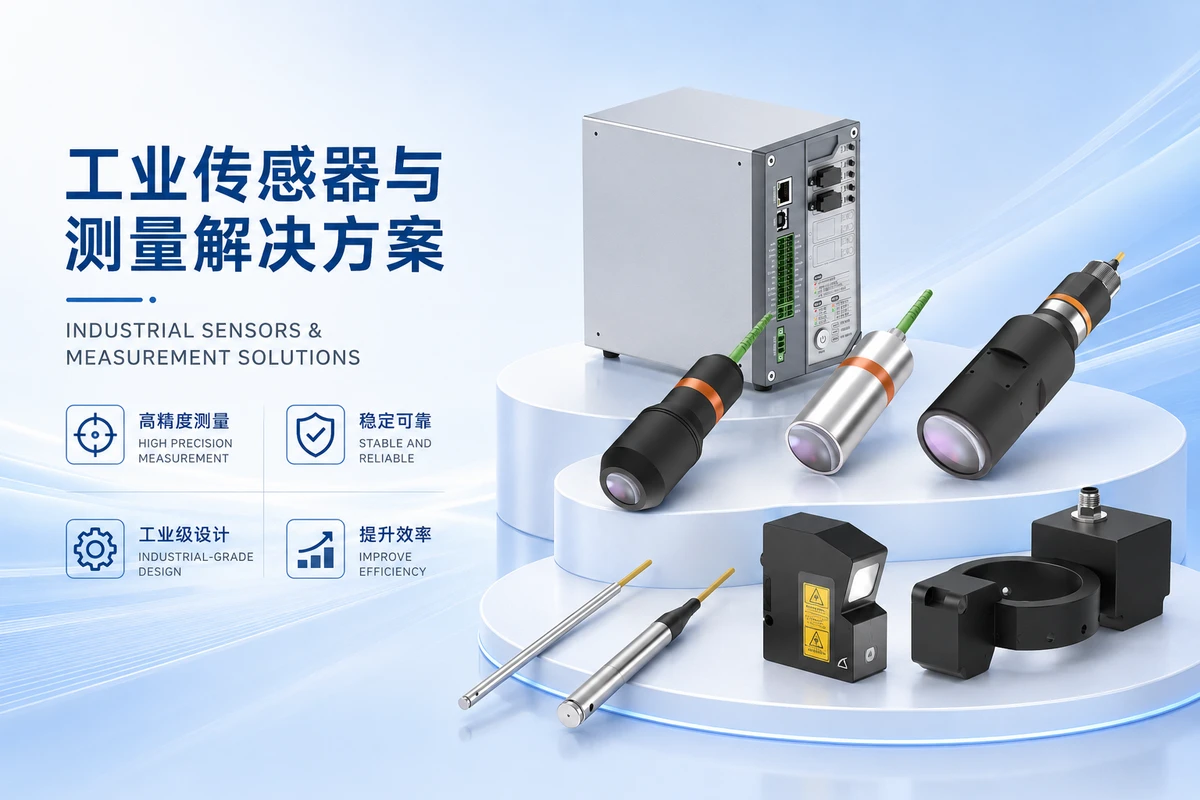
In semiconductor wafer testing, the probe station must precisely control the contact pressure and position between the probe and the wafer pad. The accuracy of Z-axis height feedback directly affects test yield and probe life. Traditional contact sensors suffer from wear and slow response, while the ST-P series laser displacement sensor uses laser triangulation for non-contact measurement, providing real-time Z-axis height feedback suitable for probe stations, wafer handling, and packaging inspection.
Detection Object and Purpose
Detection Object: Wafer surface, probe card, chuck height.
Detection Purpose: Real-time monitoring of Z-axis position to ensure uniform contact force between probe and pad, avoiding overpressure damage to the wafer or underpressure causing poor contact.
On-Site Pain Points
Wafer surface reflection, transparency, or thin films affect optical measurement stability.
High-speed movement of the probe station requires the sensor to have a high sampling rate (e.g., 160 kHz) to capture instantaneous position.
Limited installation space requires a compact sensor that is easy to integrate.
The ST-P series is based on laser triangulation, where a laser beam is emitted from the sensor to the surface of the object being measured. The reflected light is imaged onto the CMOS sensor through a lens, and the distance is calculated by measuring the displacement of the light spot. When selecting a model, the installation distance and accuracy requirements must be considered:
Model Reference Distance Measurement Range Repeatability Linearity Error ST-P25, Detection range 25mm±1mm, Repeatability 0.05μm, Linearity Error <±0.6μm; ST-P30, Detection range 30mm±5mm, Repeatability 0.15μm, Linearity Error <±3μm; ST-P50, Detection range 50mm±10mm, Repeatability 0.25μm, Linearity Error <±4μm; ST-P80, Detection range 80mm±15mm, Repeatability 0.5μm, Linearity Error <±6μm; ST-P150, Detection range 150mm±40mm, Repeatability 1.2μm, Linearity Error <±16μm
For probe station Z-axis detection, ST-P25 or ST-P30 are recommended due to their high repeatability and smaller measurement range, suitable for close-range, high-precision feedback. The specific model needs to be confirmed based on the actual installation distance and accuracy requirements.
Solution Recommendation
Mount the sensor vertically above the probe station, aiming at the wafer surface or chuck. The sensor outputs height data via Ethernet or RS485 to the motion controller for closed-loop control. For high-speed scenarios, analog output (4-20 mA or 0-10 V) can be used to directly connect to a PLC. Note: For reflective or transparent wafer surfaces, sample testing is required to verify measurement stability.
Installation and Adjustment Suggestions
Ensure the sensor optical axis is perpendicular to the measured surface, with tilt angle not exceeding ±2°.
Avoid direct ambient light on the sensor receiver window; install a light shield if necessary.
Calibrate the zero point using a standard gauge block after installation and check periodically.
For mirror or transparent materials, adjust the sensor angle or use a polarizer to reduce interference.
Frequently Asked Questions
Q: What if the wafer surface reflection causes unstable measurement?
A: Try adjusting the sensor installation angle or use the special surface mode of the ST-P series (confirm model support). Sample testing is recommended.
Q: How does the sensor communicate with a PLC?
A: It supports Ethernet, RS485, analog, and IO outputs. Choose based on the fieldbus type.
Conclusion
The ST-P series laser displacement sensor provides a non-contact, high-precision solution for probe station Z-axis height feedback. Selection should consider installation distance, accuracy, and surface characteristics, and be verified through sample testing. This series can also be used for wafer flatness, warpage, package height, and other inspections, contributing to quality improvement in semiconductor automated production lines.