
Application Background
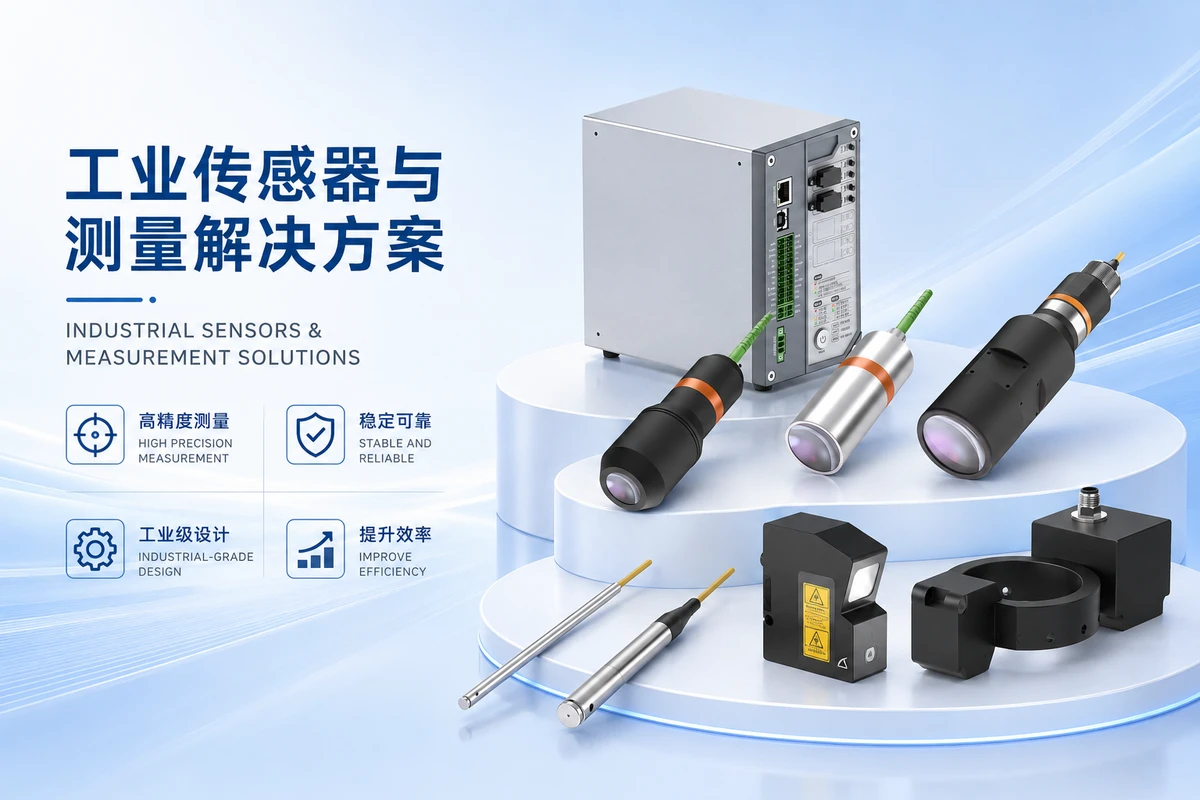
In semiconductor manufacturing, equipment micro-vibration and stage runout directly affect wafer processing accuracy, packaging quality, and equipment stability. For example, minor runout of a wafer stage during high-speed motion can cause exposure or etching position shifts; vibration of a probe station Z-axis during contact testing impacts measurement repeatability. The ST-P series laser displacement sensors use laser triangulation non-contact measurement to monitor displacement changes in real time, providing high-precision feedback for semiconductor equipment.
Product Principle and Selection Guide
The ST-P series sensors are based on the laser triangulation principle: a laser beam is emitted onto the target surface, the reflected light is imaged on a CMOS sensor via a lens, and the displacement is calculated from the change in spot position. For different measurement distances and accuracy requirements, the following models are available:
- ST-P25: Reference distance 25 mm, measurement range ±1 mm, repeatability 0.05 μm, linearity error < ±0.6 μm. Suitable for ultra-precision stage runout detection.
- ST-P30: Reference distance 30 mm, measurement range ±5 mm, repeatability 0.15 μm, linearity error < ±3 μm. Suitable for wafer height measurement.
- ST-P50: Reference distance 50 mm, measurement range ±10 mm, repeatability 0.25 μm, linearity error < ±4 μm. Used for wafer warpage detection.
- ST-P80: Reference distance 80 mm, measurement range ±15 mm, repeatability 0.5 μm, linearity error < ±6 μm. Suitable for package height measurement.
- ST-P150: Reference distance 150 mm, measurement range ±40 mm, repeatability 1.2 μm, linearity error < ±16 μm. Suitable for large-range step height measurement.
The maximum sampling frequency reaches 160 kHz, supporting Ethernet, RS485, analog, and IO outputs, which can be integrated with PLCs, host computers, or motion control platforms.
Solution Recommendations
Micro-Vibration Detection
Mount the sensor rigidly on the equipment base, with the laser beam perpendicular to the target stage (e.g., wafer stage). Use analog output or Ethernet to collect displacement data in real time. The sampling frequency should be at least twice the highest vibration frequency. For reflective or transparent materials, adjust the installation angle to avoid glare interference; sample testing is recommended.
Stage Runout Detection
Install multiple sensors along the stage motion path to measure runout at different positions. For example, use the ST-P25 to detect axial runout of a precision stage, with repeatability of 0.05 μm meeting nanometer-level requirements. Data can be transmitted via RS485 or Ethernet to a host computer for FFT analysis.
Installation and Commissioning Tips
- Ensure the sensor is firmly mounted to avoid self-induced vibration errors.
- The laser beam should be perpendicular to the target surface; tilt angle should not exceed ±5°.
- For highly reflective surfaces (e.g., mirror metals), use a diffuse reflection target or adjust the angle; surface treatment may be necessary.
- Perform linear calibration before first use to ensure measurement accuracy.
- Be aware of ambient light interference; install a light shield if needed.
Frequently Asked Questions
Q: Can the sensor detect transparent materials (e.g., glass wafers)?
A: Transparent materials cause laser penetration, affecting measurement. It is recommended to spray a developer or use a reflective film, or consider a confocal sensor (to be confirmed separately).
Q: How to select the sampling frequency?
A: The sampling frequency should be 2–5 times the highest vibration frequency. The ST-P series supports up to 160 kHz, meeting most semiconductor equipment requirements.
Q: How to interface the output with a PLC?
A: The sensor supports analog (4–20 mA or 0–10 V), RS485 (Modbus RTU), and Ethernet (Modbus TCP) outputs. Choose according to the PLC interface.
Conclusion
The ST-P series laser displacement sensors, with high accuracy, high sampling rate, and multiple output options, are suitable for micro-vibration and stage runout detection in semiconductor equipment. Selection should be based on measurement distance, accuracy requirements, and material characteristics; sample testing under actual conditions is recommended. This article explains the measurement approach; final models, parameters, installation details, and images should match confirmed product data and site conditions.